Sunday, March 15, 2009

Mankiw's Lessons From The President's Budget

GREG MANKIW takes a look at President Obama's first budget proposal. He finds several lessons revealed in this proposal: (1) he is an economic optimist, especially concerning his PLAN (assumes 4% growth rate in the economy over the next 4 years), (2) he likes to spend, (3) he is serious about climate change, and (4) he is a deficit dove (i.e., the deficits are rising with his plans).

I guess I'm not surprised by any of the lessons Mankiw sees in the President's first budget. His campaign speeches suggested he would be a big spender, and of course if so, then most likely he would really be a deficit dove. And, what President wouldn't choose a rosy scenario for economic growth when assuming the President's PLAN for government and the economy was implemented?

But, it seems to me the assumption of 4% growth over the next 4 years is quite inconsistent with assuming the President will successfully impose carbon cap-and-trade policies. If government policy forces significant additional reductions in carbon emissions, the relative prices of energy will be much increased, which will reduce both consumption and production.

Here is the bottom line in Mankiw's commentary:
"So if you are a deficit hawk who lamented the Bush budget deficits, the new president’s budget should not make you feel much better. President Obama offers different fiscal priorities than President Bush did: less military spending, more domestic spending and higher marginal tax rates to “spread the wealth around.” But the borrowing and debt imposed on future generations will not be very different, at least if the numbers in the Obama administration’s own budget document can be trusted."

Saturday, March 14, 2009

The Cookie Cartel

From the WASHINGTON TIMES:
Wild Freeborn — adorable and age 8 — has caused considerable hubbub with entrepreneurial spirit and a little homemade video.

"Help me help others. Buy cookies. They're yummy," little Wild says in her one-minute sales pitch for Thin Mints, Samoas and other traditional mainstays of Girl Scout cookie cuisine.

The modest message included an online order form, was videotaped by her father, Bryan Freeborn, in the family living room in Brevard, N.C., and posted at YouTube.com

[ . . . ]

The Girl Scouts were not pleased with Wild's intention to sell 12,000 boxes of cookies and help send her troop to summer camp. The organization ordered the video removed from the social-networking site on the grounds that it violated a policy that bars online sales of Girl Scout cookies. Officials were also concerned that Wild's methods could put less techno-enabled young ladies at a disadvantage.

Thursday, March 05, 2009

Federal Government Changes Size

GREG MANKIW looks at federal outlays as a percent of GDP, which seems to be something President Obama wants to change in the direction of larger and larger:
"HOW WILL IT ALL END? Over the last century, the largest increase in the size of the government occurred during the Great Depression and World War II. Even after these crises were over, they left a legacy of higher spending and taxes. To this day, we have yet to come to grips with how to pay for all that the government created during that era — a problem that will become acute as more baby boomers retire and start collecting the benefits promised.

Rahm Emanuel, the incoming White House chief of staff, has said, “You don’t ever want to let a crisis go to waste: it’s an opportunity to do important things that you would otherwise avoid.”

What he has in mind is not entirely clear. One possibility is that he wants to use a temporary crisis as a pretense for engineering a permanent increase in the size and scope of the government. Believers in limited government have reason to be wary."

The Corruption Continues

WSJ:
"Speaking of earmarks, they've quickly made a comeback even by the old definition. The $410 billion omnibus spending bill for fiscal 2009 now making its way through Congress contains at least 8,570 of them at a cost of $7.7 billion. Mr. Obama is not signaling any concern, much less a veto."
Please read this short editorial. We should all be paying attention. The corruption in Washington continues. It seems to me the corruption that is represented by earmarks is not being changed to un-corruption, but instead the direction of change we seem to be able to count out is a deepening of the corruption.

The number of earmarks in this omnibus spending bill alone represents, on average, about 20 personally determined, secret, spending projects for each member of Congress. In dollar terms, this means about $18 million is being spent secretly by each member of Congress.

Monday, March 02, 2009

President's Road Map?

CONGRESSMAN PAUL RYAN:
"The budget the president released last week, however, does provide some certainty about where we are headed: higher taxes on small businesses, work and capital investment.

Add to this the costly burdens of a cap-and-trade carbon emissions scheme and an effective nationalization of health care, and it is clear that the government is going to grow while the economy will shrink. In a nutshell, the president's budget seemingly seeks to replace the American political idea of equalizing opportunity with the European notion of equalizing results."
It seems to me this is the President's vision of the future, and it's not a vision I like? What do you say?

Wednesday, February 25, 2009

Seen & Unseen

I didn't watch the President's speech last night. I had to walk my dog. And, I haven't yet had time to read his speech, so I can't comment directly. But STEVE HORWITZ watched it, well he apparently watched as long as he could take it:
"It is quite clear after listening to Obama's talk tonight that he, and those who applauded him wildly, have no clue as to this fundamental point in political economy. Not once in all of his talk of what government would do did he ever even come close to acknowledging that what government spends on the one hand must be taken from the private spending stream on the other. In fact, at one point he touted his 'transparency' plan by saying that it would enable 'taxpayers to see how government money is being spent helping other taxpayers.' Maybe so, but he glosses over the fact that the money being spent came from those same taxpayers and would have been spent on other things, without the waste of the transfer, were it not for government's intervention. Robbing Peter to 'help' Paul only damages both in the process, and certainly stimulates no economic activity."

This Crisis & Sowell Clarity

TOM SOWELL:
"From television specials to newspaper editorials, the media are pushing the idea that current economic problems were caused by the market and that only the government can rescue us.

What was lacking in the housing market, they say, was government regulation of the market's 'greed.' That makes great moral melodrama, but it turns the facts upside down.

It was precisely government intervention which turned a thriving industry into a basket case.

An economist specializing in financial markets gave a glimpse of the history of housing markets when he said: 'Lending money to American homebuyers had been one of the least risky and most profitable businesses a bank could engage in for nearly a century.'

That was what the market was like before the government intervened. Like many government interventions, it began small and later grew."
If you want insight, then you really should read the whole thing.

On the other hand, if you choose either rational ignorance or irrationality, then you want to stay far, far away from Tom Sowell.

Tuesday, February 24, 2009

Presidential Confidence?


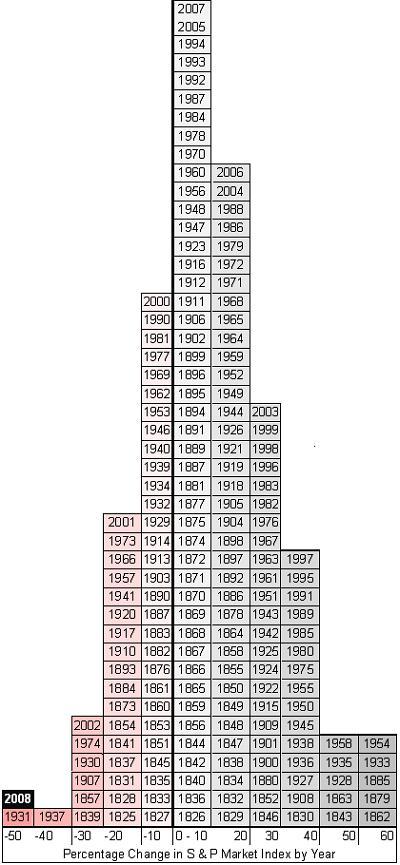
I've recently heard quite a number of talking heads discussing what has happened with the stock market indexes since the election of President Obama. I found this chart in A WSJ COMMENTARY today. Perhaps this suggests a lack of confidence in the new President. Then again, it could also reflect a lack of confidence in a Congress which already seems adamantly partisan and Democrat.

In any case, it seems the more Washington says it will fix the economy and this recession, the more it looks like the recession will continue. It seems to me that an increasingly interventionist Washington is making matters worse, not better.

Monday, February 23, 2009

Reflections in the Times of Hysteria

VICTOR DAVIS HANSON'S insights on post-modern poverty in this time of recession:
"And for the less fortunate? Here is southern Fresno County, at ground zero of the illegal immigration explosion, where unemployment reaches 14%, agriculture is in the doldrums and construction and manufacturing fare worse, the depression among the poor is still ambiguous, at least in historical terms.

I went into the local Food 4-Less again the other day, a cut-rate, bulk-buy chain food store. The parking lot was full of late model trucks and cars—not the sort I prefer, but those V-8 monsters, loaded up with high-priced rims, wide tires, custom paint, tinted windows, oversized trailer hitches, the whole American shebang so to speak that tops out at around $40,000. The customers may have been out of work, but I counted nine, just nine, of some 100 (this was a research trip for this blog posting), who did not have one of the following four appurtencies visible—cell phone, Bluetooth, blackberry-like device, I-pod. On the way out of the parking lot, the car radio was blaring with three sorts of ads: get out of credit card debt, get out of mortgage debt, get out of back IRS payments—now! Easy! Little cash upfront! This is not Bleak House as we are led to believe.

We are hurting, but not in 1933 fashion, due both to expanded government entitlements; Chinese-made cheap consumer goods; the fumes of past easy credit; black market, untaxed temporary cash and carry jobs (a vastly underestimated source of enormous income); and a culture that absolves one of the shame of reneging on debt (or perhaps even admires the possibility of a phoenix-like resurgence from loser to winner, and has a grudging admiration for the machinations involved in such rebirth).

I’m not sure this is even the 1979-83 recession where finally we got 10%-plus unemployment, 18% interest, and 12% inflation—a topic I once devoted a book to, Fields Without Dreams. Then I remember seeing Cryolite bags go up 10% every six months. I remember raisin prices going down from $1400 a ton to about $450. I remember vineyard prices falling from $15,000 an acre to $3500. I remember taking out Federal Land Bank loans at 13%, and short-term Bank of America crop loans at 15%. And I remember pickers getting 22 cents a grape tray in 1980—and 11 cents in 1983. I bought a used Pontiac Grand Prix (a fixer-upper that had been totaled) for 12% interest. So, I am sorry. This is not quite yet the early eighties recession, and I am not yet convinced that the baby-boomer generation that has come of age cannot ride this out without adopting European-socialism as a cure."
Let's certainly hope there is enough good sense left in this republic to steer clear of European-socialism, because if not, our past prosperity will become a remembrance rather than a prelude to our future prosperity.

But, alas, the recent election of a President-as-savior for so many, combined with the rationally ignorant and the rationally irrational, may well mean there is not enough good sense left in this republic.

Wednesday, February 18, 2009

National Debt History

JOHN STEELE GORDON:
"Still, it's the trend that is worrisome, to put it mildly. There have always been two reasons for adding to the national debt. One is to fight wars. The second is to counteract recessions. But while the national debt in 1982 was 35% of GDP, after a quarter century of nearly uninterrupted economic growth and the end of the Cold War the debt-to-GDP ratio has more than doubled.

It is hard to escape the idea that this happened only because Democrats and Republicans alike never said no to any significant interest group. Despite a genuine economic emergency, the stimulus bill is more about dispensing goodies to Democratic interest groups than stimulating the economy. Even Sen. Charles Schumer (D., N.Y.) -- no deficit hawk when his party is in the majority -- called it 'porky.'"
Our political economy is again beginning to show symptoms of the sclerosis Mancur Olson studied in THE RISE AND DECLINE OF NATIONS.

Monday, February 16, 2009

Free vs. Big

You might want to CHECK THIS OUT.

Perverse Incentives

PETER BOETTKE:
"Barney Frank was on Face the Nation this morning talking about the problems of perverse incentives created by the current policies. These guys, he said, can make risky decisions and make great profits, but if the turn out to be wrong decisions they don't have to worry about all the loss. Congressman Frank argues that we need to change this. REALLY???

It would have been nice if he knew that basic lesson of economics before he pushed for a lowering of lending standards over a decade ago. But while he might have learned something in the process about incentives decision makers face, he hasn't learned that the current set of rule changes being advocated are simply augmenting the perversity rather than countering it."
Well put!

1st Amendment Economic Liberties

ED MORRISSEY:
"It’s an easy question. Does this administration believe in free speech or government censorship? Their sudden inability to provide a clear answer, when they had no problem giving such assurances eight months ago, does not bode well for the answer.

I’d like to say I told you so to all of those who accused us of paranoia, but the window on that ability to do so on the airwaves looks like it’s about to expire — like all of Obama’s campaign promises."
Check it out. An expiration date on the President's campaign promises, eh? Rational ignorance comes up again.

The policies falling under the idea of the "fairness doctrine" pose threats not just to speech and press liberties. The idea is going to be for government to force the owners of radio stations to make business choices with respect to their programming that they would otherwise not choose to make. So, economic liberties are going to be threatened as well.

Such threats to economic liberty seem to be part of this President's vision for the future of America, because we also have seen since his inauguration that he intends to cap pay for business executives and he is going to have a AUTO INDUSTRY COUNCIL that will restructure this US industry.

Hey, remember the song lyric "the future's so bright I gotta wear shades"? It's beginning to look like we can throw those shades away.

Politics, Ain't It Grand

ROGER KIMBALL WRITES, "now they tell us:"
"They haven’t even extracted the money yet and already they’re telling us poor suckers “not to expect instant miracles from the $787 billion economic stimulus bill he will sign this week, but said it would help eventually.”

. . . . White House spokesman Robert Gibbs today said that “the economy is going to get worse before it gets better.”

And what about the 3.5 million jobs the current President of the United States said his spending orgy would “save or create.” (Save or create? What does that mean? How would you measure the saved jobs?))

Oops, now it’s 2.5 million by the end of 2010."
Didn't the President say he would create 4 million new jobs? It seems the choices of our fearless leaders in Washington depend heavily on assuming voters are rationally ignorant. But, isn't this past week just a bit too much, as in: "Oh, my, the sky is falling. . . .We must do something. . . .Let's spend, spend, spend so we can save/create jobs. . . .But, never mind, now that our legislation has passed, don't hold you breath, because, you see, we really don't think our spending can change the direction of the economy any way."

Remember hope and change? I hope the change to a larger government in Washington doesn't continue, but there are still many months until mid-term Congressional elections.

Wednesday, January 28, 2009

Unemployed Trojan Horse

ALAN REYNOLDS wonders why most of Congressional stimulus bill is directed toward areas of the economy with little unemployment:
"House Democrats propose to spend $550 billion of their two-year, $825 billion 'stimulus bill' (the rest of it being tax cuts). Most of the spending is unlikely to be timely or temporary. Strangely, most of it is targeted toward sectors of the economy where unemployment is the lowest.

The December unemployment rate was only 2.3% for government workers and 3.8% in education and health. Unemployment rates in manufacturing and construction, by contrast, were 8.3% and 15.2% respectively. Yet 39% of the $550 billion in the bill would go to state and local governments. Another 17.3% would go to health and education -- sectors where relatively secure government jobs are also prevalent.

If the intent of the plan is to alleviate unemployment, why spend over half of the money on sectors where unemployment is lowest?"
Do our fearless leaders in Washington really overlook such details? Or, do they know well what they are doing and assume most of us are not watching? Are our fearless leaders confident they are safe in trying to fool us because most of us choose rational ignorance and/or rational irrationality?

Another View of the Trojan Horse

WSJ EDITORIAL:
"'Never let a serious crisis go to waste. What I mean by that is it's an opportunity to do things you couldn't do before.'

So said White House Chief of Staff Rahm Emanuel in November, and Democrats in Congress are certainly taking his advice to heart. The 647-page, $825 billion House legislation is being sold as an economic 'stimulus,' but now that Democrats have finally released the details we understand Rahm's point much better. This is a political wonder that manages to spend money on just about every pent-up Democratic proposal of the last 40 years.

We've looked it over, and even we can't quite believe it. There's $1 billion for Amtrak, the federal railroad that hasn't turned a profit in 40 years; $2 billion for child-care subsidies; $50 million for that great engine of job creation, the National Endowment for the Arts; $400 million for global-warming research and another $2.4 billion for carbon-capture demonstration projects. There's even $650 million on top of the billions already doled out to pay for digital TV conversion coupons."

Tuesday, January 27, 2009

On Economic Stimulus: Don't Worry, Be Happy

Every where I look these days economists are writing about government stimulus to remove us from our recessionary times. ROBERT HIGGS waxes poetic:
"It’s pointless if you make a fuss
About Obama’s stimulus.
The government’s determined, see,
To rescue the economy.
Paul Krugman’s here to point the way
Toward a bright and shining day,
When everyone will be employed
And all consumers overjoyed.
The Fed’s enormous loans will serve
To calm the frightened banker’s nerves,
And Congress will serve pork and beans
To cronies fat, to peasants lean.

* * *

We’ve no need to panic, the world’s in good hands.
Financial details, Old Ben understands.
He’ll huff and he’ll puff, and he’ll spew dollars out,
He won’t stop to rest till he’s quelled every doubt
That dollars created from thin air each session
Are all that we need to steer clear of depression."
STEVE HORWITZ warns that he smells a rat:
"One of the (correct) complaints about the proposed stimulus plan is that it's full of all kinds of programs that would appear to have nothing to do with any accepted economic theory about what sorts of spending could even possibly lead to recovery. The best example of this is the funds for family planning policy that are in the bill. Of course to those who understand public choice, none of this is a surprise. One good argument against a stimulus package is that any package will necessarily have more pork in it than the Dinosaur BBQ.

That all said, I think there's something else at work here. This isn't just your run-of-the-mill pork. What we are seeing happen right now is that Congress sees this crisis as an opportunity to enact a whole variety of programs that they've wanted to pass for years, especially (but not only) the Democrats who no longer fear a veto, and now finally have the chance. Just as the Patriot Act was a bunch of laws waiting for a political 'crisis,' so is much of the stimulus package a bunch of programs waiting for an economic 'crisis.' The current crisis is just a convenient excuse.

[ . . . ]

Bottom line: the more that those of us who are skeptical continue to even refer to this as a "stimulus" plan, the more we play into the other side's hands. This isn't a stimulus package, it's a whole bunch of programs designed to extend the state's role in the economy and in our personal lives, and to do so at enormous cost to us, and to our children and grandchildren. Let's challenge the rhetoric of fear and crisis and name this for what it is: the current majority's attempt to do exactly what the Bush Administration did post-9/11, which is to use fear and crisis to pass programs that will impoverish us and curtail our freedoms, and to do so with the minimum of serious debate possible."
Non-economist DICK MORRIS captures the Horwitz warning with a charming image:
"But Obama’s strategy is to hide inside the Trojan Horse of stimulus an army of radical measures to change America permanently.

The most pernicious of his proposals will be the massive Make Work Pay refundable tax credit. Dressed up as a tax cut, it will be a national welfare program, guaranteeing a majority of American households an annual check to “refund” taxes they never paid. And it will eliminate the need for about 20% of American households to pay income taxes, lifting the proportion that need not do so to a majority of the voting population. Unlike the Bush stimulus checks, this new program will be a permanent entitlement, a part of our budget that can only go up and never down. Politically, it will transform a majority of Americans from taxpayers, anxious to hold down government spending, into tax eaters, eager to reap new benefits."
If you would like to see for yourself just exactly what Congress calls economic stimulus, then you should check out the web site READ THE STIMULUS. Be sure to open the SPREADSHEET you can find there.

But don't worry, be happy. After all, our great, powerful, and wise democracy has spoken.

The Nature of Government

WILLIAM SHUGHART writes about the government stimulus idea. His bottom line points to a key attribute of government:
"Companies usually risk their own money. In Washington, the politicians will be risking ours."

Thursday, January 08, 2009

The Nature of Politics -- Fannie & Freddie

KARL ROVE:
"When Republican Richard Shelby of Alabama, then chairman of the Senate Banking Committee, pushed for comprehensive GSE reform in 2005, Democrat Sen. Chris Dodd of Connecticut successfully threatened a filibuster. Later, after Fannie and Freddie collapsed, Mr. Dodd asked, 'Why weren't we doing more?' He then voted for the Bush reforms that he once called 'ill-advised.'

But Mr. Dodd wasn't the only Democrat to heap abuse on the Bush reforms. Rep. Barney Frank of Massachusetts defended Fannie and Freddie as 'fundamentally sound' and labeled the president's proposals as 'inane.' He later voted for the reforms. Sen. Charles Schumer of New York dismissed Mr. Bush's 'safety and soundness concerns' as 'a straw man.' 'If it ain't broke, don't fix it,' was the helpful advice of both Sen. Thomas Carper of Delaware and Rep. Maxine Waters of California. Rep. Kendrick Meeks of Florida berated a Bush official at a hearing, saying, 'I am just pissed off' at the administration for raising the issue."
Politicians are such interesting people, wouldn't you say?

Part of my upcoming semester will be devoted to talking with students about public choice economics. One of the basic ideas that we will explore is that voters choose to be rationally ignorant. The idea is that an individual voter likely believes that he or she cannot determine the outcome of an election, and therefore decides to spend little, if any, time becoming well-informed about issues and about the positions and records of politicians. It seems to me that Mr. Rove's commentary illustrates one of the implications of such rational ignorance. Specifically, politicians are able to get away with saying in the present things that are not at all true about their votes and positions in the past.

I would also say that politicians are themselves well aware that most voters are rationally ignorant.

One might hope that a free press would mitigate the unfortunate implications of rational ignorance, but I think Mr. Rove's commentary points out why I think that this is not really to be expected. Even if the press and the news industry work hard at holding politicians accountable for their past actions vis a vis their present assertions, the rationally ignorant voter is paying very little attention. I suspect the press and the news industry has come to recognize the electorate is largely rationally ignorant, and this means members of the press and the news industry know that they too cannot be easily held accountable for inconsistencies between past stories and present stories. In addition, most voters simply are unlikely to spend the time to discover which news suppliers are keeping tabs on the inconsistencies and the outright lies of the politicians.

A few of my friends have wondered why it seems no one saw the problems that were to result from public policy with respect to Fannie & Freddie. I don't think no one saw the potential problems. Economists often point out to their students, and anyone one else who will listen for that matter, that when government subsidizes risk taking the result is too much risk taking, and eventually the (overly risky) chickens will come home to roost. This is a large part of the story of the present financial situation. What is not possible to predict is specifically when and in what specific ways those chickens will come home to roost. Mr. Rove's commentary points out that there were people, economists and even politicians, who made efforts to mitigate the problems that were to come as a result of bad public policy toward mortgages, but successful politics is often bad economic policy. The politics of Fannie & Freddie ruled the day, and the politicians who failed to act to mitigate or reduce the risk of this financial failure seem to be largely escaping accountability. This seems the nature of politics because voters choose to be rationally ignorant.

Some people understand this about the nature of politics, and they suggest making efforts toward political reforms. But, politics is politics. I don't think much of this can be changed, especially when the unfortunate aspects of politics follow from the choices of voters to be rationally ignorant. If we understand the inherent nature of politics and government, then we should understand that this nature cannot be changed, and instead efforts and attention should be focused on constraining the list of things government is allowed to do. Governments really should not be allowed to subsidize risk taking.

Monday, January 05, 2009

Thursday, December 18, 2008

Carbon Corrective Tax

Soon to be President Obama seems interested in "energy independence," and he is touting the idea that there are many, many new green jobs to be created in pursuit of energy independence. One of the new President's reasons to support energy independence seems to be his concern that carbon fuels are culprits in global warming. Hey, sounds like Mr. Obama wants to correct a negative externality. Of course, the economic approach to correcting a negative externality does not involve government regulations about fuel economy, and it doesn't involve subsidizing "green energy." The economic approach would be to use a corrective tax. ARTHUR B. LAFFER offers an application of the economic approach with the following:
"The Obama team's chatter about creating jobs in alternative renewable energies is hollow to say the least. Here's why: Any serious attempt to reduce carbon emissions must ultimately rely on a very large tax on the use of fossil fuels. And a very large tax on fossil fuels as an add-on to the taxes we already pay would drive the economy deeper into the ground -- with or without alternative renewable energy jobs.

The only real solution is Al Gore's proposal to offset a carbon tax dollar-for-dollar with either an income or payroll tax reduction. If a carbon tax increase were offset dollar-for-dollar with an income tax rate cut, I for one would strongly support the policy. The economy would benefit because the progressive income tax does far more damage than a carbon tax would, and we'd use less oil. It's a win-win situation. Yet this perspective appears to be totally outside the Obama team's ken."

Saturday, December 13, 2008

Rules & Purposes

Hayek in Law, Legislation and Liberty, Volume 1: Rules and Order:
Man is as much a rule-following animal as a purpose-seeking one.
It seems to me most of economics emphasizes the purpose-seeking and pretty much misses the rule-following. Does this mean economics misses about half of what it should pay attention to?

Thursday, December 11, 2008

Are Bailouts Regulation?

CHRISTOPHER COX:
"When the Securities and Exchange Commission was created in 1934, its purpose was to serve as an independent regulator of the unbridled profit-seeking activity of self-interested individuals and firms in the securities markets. It was not intended to supplant the market or directly participate in it. Instead, it marked a deliberate effort to clearly define and separate the role of the national government, on the one hand, and the capital markets, on the other."

Henceforth, fraud and unfair dealing in the stock and bond markets would be subjected to external discipline by the federal government. Minimum standards would be enforced, such as requiring that investors be told the essential details about securities in which they were investing. Registration of securities and licensing of broker-dealers would be required. It was, in short, arms-length regulation of an unabashedly private market.

Over the years, the agency has acquired three explicit goals: protecting investors; maintaining fair and orderly markets; and promoting capital formation. These three complementary missions are logically consistent with the original premise of the securities laws, which was that government is an auxiliary to the market, not a substitute for it or a participant in it. Virtually every aspect of the 1933 and 1934 Acts, and the regulations implementing them, follows from the notion that markets should be efficient, competitive, transparent and free of fraud.
I think this puts in perspective an issue that ought to be raised: Is it constitutional for our national government to make efforts to "bail out" industries and businesses? And, is it constitutional for our national government to become a participant in financial markets by becoming a shareholder and therefore an owner in financial businesses? It seems to me the answer should be no.

The Constitution grants Congress the enumerated power to regulate interstate commerce. It seems to me this means Congress has the power to write a set of rules by which financial businesses will operate. Mr. Cox describes these sorts of rules in the quotation above.

But "regulation" does not mean offering loans to businesses to keep them from bankruptcy. And, I can't find in Artcile 1 Section 8 of the Constitution that Congress has the enumerated power to essentially be in the business of loaning money, whether for mortgages or for saving businesses and industries.

It seems to me "regulation" does not include use of a government official as a car czar, as I understand the auto industry "bail-out" bill does, who will approve or disapprove specific aspects of efforts by auto industry businesses to restructure in an effort to be more competitive in the future.

And, surely, the power to regulate interstate commerce does not include the power to own the very businesses Congress has the power to regulate.

Unfortunately, as Hayek wrote, "the basic principles on which this civilization was built have been falling into increasing disregard and oblivion."

Sunday, December 07, 2008

Saturday, December 06, 2008

Who is Less Free than 40 Years Ago?

SHANNON LOVE:
"Anyone who actually creates new wealth has seen their freedom to create attacked in the last 40 years. Farmers, builders, manufactures and small business people all have seen their choices progressively reduced. Individuals have far fewer choices when it comes to such activities as raising crops, building houses, building factories, designing products, setting work rules or even running a corner store.

Most of us do not see this contraction of freedom because we are not actual economic creatives. Most of us work for creatives, we ourselves do not create the businesses that pay us or the products and services they sell. We merely implement the innovations of others. We do not personally bump our noses against the government restrictions that the people who employ us and sell to us do.

Restricting the freedom of economic creatives ultimately restricts the freedoms of everyone. Without the material necessities and luxuries provided by the creatives, the rest of us cannot implement our own choices."
Who is less free than 40 years ago? Sounds like we all are.

Tuesday, December 02, 2008

Economics Of Corners

SANDY IKEDA:
"Jacobs stresses the importance of corners for overall economic development in a city, or more precisely, she argues that, ceteris paribus, short blocks are preferable to long blocks (which translates to more corners). Having shorter blocks and more corners multiplies the ways of getting from point A to point B, which enables pedestrians (and drivers) to experience more diversity of use at street level, and offers vendors more good locations to supply that diversity, than otherwise. Because roughly twice as many people will pass by a corner property per hour than locations at mid-block, the former naturally tend to be pricier than the latter.

A rule of thumb for the success of an urban center is that about 1000 persons need to pass through every hour (see Joel Garreaus’s Edge City). Short blocks and multiple corners make this more likely, as people who find streetscapes interesting tend to attract still more people, and more business."

Africa Power & Prosperity

STRATEGY PAGE:
"Money alone won't solve the problem of tribal violence, Honest government will. But you can't easily buy that. The locals have to put aside centuries of custom to make government work. That won't happen fast, and when it does, it will take a long time to eliminate the tribal loyalties. Meanwhile, Africa is a grim example of survival of the fittest. Resourceful and ruthless men, abetted by cheap guns and natural resources to plunder, thrive, while proponents of civil society and honest government cower in the shadows."
Read the whole piece. It is a nice summary of history relevant to power and prosperity.

The Story of the Schechter Brothers

For students in my Constitution & the Economy course, you might be interested in learning more of the story behind the Schechter opinion. STEVE HORWITZ tells about this story, and he suggests an interesting economic story is involved as well:
". . . there’s a terrific dissertation waiting to be written that explores the Laws of Kashrut as a set of informal institutions that serve as a non-governmental health code. It would be a project complementary to Lisa Bernstein’s work on the informal norms of the diamond industry. That story is only made better by the role the NRA played in overriding the, arguably superior, private sector arrangements within the Jewish community. The NRA’s attempt at cartelizing and planning all of these industries destroyed the indigenous institutions that functioned better."

Saturday, November 29, 2008

Wind & Collective Action


There is an article in the NY Times that tells of an interesting application of Mancur Olson's Logic of Collective Action. Ranchers in Wyoming are forming wind energy associations. Here is an explanation of the incentives for these new associations:
Mr. Stumbough felt the ranchers were at a disadvantage when dealing individually with wind developers. The developers, in most cases, know more than landowners about the value of the wind and the transmission lines that will carry it.

[ . . . ]

"Mr. Stumbough said: “I thought we could use collective bargaining strategies to maybe have a little more leverage in negotiating with wind developers. If we could all get together and work together cooperatively and do some cost sharing and maybe share some of the profits, I think it’s going to be a benefit to everybody.”"
Cost and profit sharing represents collective goods for the associations.

Note also the information problem suggested in the first paragraph. This reminds me of Hayek's The Use of Knowledge in Society. The individual landowners face a personal knowledge problem of wanting to discover the value of leasing their property for wind energy production. The associations are voluntary means of dealing with this problem. The relative values of resources in different uses are also emerging in prices for leases as well as prices for the electicity produced by wind turbines.

This situation also looks like it involves the information asymmetry often described as a source of market failure. But, the association's seem to me to be a market answer, in this case, to this supposed market failure. Thus, it is an illustration of why I am skeptical about information asymmetry as a legitimate source of market failure.

There are a couple of things in the story that concern me from the perspective of economic understanding or economic literacy. One is the caption under one of the photos:
Strong winds in southeastern Wyoming have forced landowners together to improve bargaining position.
Nothing, and especially not strong winds, have FORCED Wyoming landowners to form these associations. These are voluntary associations; not forced associations (i.e., they are not organizations such as unions are).

The second is the implied suggestion there is something wrong with secret deals:
That has made it easier for wind developers to make individual deals and insist that the terms be kept secret. The developers’ cause has not been hurt by a 10-year drought’s impact on agricultural families’ finances.
I would think there would be something wrong in secret deals if they involved force, but surely a landowner and an energy company can ethically make a voluntary agreement that includes secrets as long as no harm is done to the person or property of others.

You can learn about some of the specifics involved in forming the Slater Wind Energy Association here.

If you've read Olson's Logic, perhaps you would comment on the way in which the number of members is related to the formation of these associatons.

Wednesday, November 19, 2008

The Ant Colony

TIBOR MACHAN:
So you notice that your income has shrunk, you may even have lost your
job. So you decide to trade in your gas guzzler for a small vehicle and
even reduce your monthly car payments, if you have such. And in other
realms of your life, too, you may be making adjustments to cope with the
general economic downturn. You cook at home instead of eating at your
favorite restaurant; you do not purchase that pair of shoes you would have
otherwise, etc., etc.

In short, you are acting prudently, tightening your belt, as the saying
goes, in the face of the widespread economic contraction. Never even mind
why the contraction occurred--some of it could actually have come around
simply from people changing their preferences and behavior. (Instead, of
course, it happened because the government has been abandoning its proper
role as the protector of our rights and like a rouge referee, has been
inserting itself into the game for decades on end!)

But now that the results of such bad government have hit so many of us,
you are taking steps to deal with them. Ah, but no such luck. Instead of
making it possible for you to deal with your reduced resources, instead of
letting you make the budgetary adjustments you can make within the context
of your own life circumstances, the politicians are insisting that if you
refuse to spend the big bucks on those Detroit gas guzzlers, for example,
they will tax you and hand over what they have extorted from you to the
car makers, never mind your prudent choices. In time the savings you
thought you could garner from your good sense and discipline will have to
be shelled out in extra taxes so as to bail out those who aren’t getting
your business any more. Instead of insisting that those who make the big
cars and whatever else that’s no longer in demand in the market place make
their own adjustments, tighten their own belts, etc., the politicians
insist that they continue to be paid as if nothing had happened, no one
changed his or her purchasing behavior, as if the economy continued to be
in fine shape.

This is just one of thousands of results of the mixed economy, the
welfare state, in which your individuality is abolished and you are
treated as a member of some ant colony or bee hive. You will be
conscripted to be part of it all, never mind how sensibly you may figure
out to deal with the fiasco. No, you will not be allowed to use your good
sense, virtue, and occasional luck to address the economic mess the
politicians, bureaucrats and their rent-seeking clients produced. These
folks were the ones who prevented the realization of the free market and
instead created a top-down, planned or managed arena of wealth
redistribution.

Monday, November 17, 2008

Elections the Venezuelan Way

MARY ANASTASIA O'GRADY:
"In recent weeks he [Mr. Chavez] has begun threatening to use the military against his own population in states where his municipal and gubernatorial candidates are defeated. On a trip to the state of Carabobo last week, for example, he told voters, 'If you let the oligarchy return to government then maybe I'll end up sending the tanks of the armored brigade out to defend the revolutionary government.' Just as troubling are the president's declarations that in states where his candidates are not elected, he will withhold federal funding."

Economics

F.A. Hayek:
"The curious task of economics is to demonstrate to men how little they really know about what they imagine they can design." [The Fatal Conceit, p. 76]
I guess few economists understand this. After all, the models economists rely on assuming complete knowledge. Even the "tools" they use, such a benefit cost analysis, presume that an economist, or perhaps two or three working together, can come to know enough to calculate the benefits and costs of public expenditures and public policy changes. Instead of attempting to "demonstrate" how little they know, they attempt to demonstrate how the complete knowledge models of a static world can help people and governments make better decisions in a real world of adaptation and evolution. Few economists seem to think the world they study is a world of adaptation and evolution.

Friday, November 14, 2008

The Loss Of Individual Liberty

PETER ROBINSON:
"All that the nation's founders understood two centuries ago about the imperative of limited government, all that we learned from the long struggle between collectivism and free markets during our own time--all this could soon simply evanesce.

We are being asked to unlearn what we know, to surrender the virtues that can only be acquired in conditions of freedom, and to become a lesser people than we are. The land of the free and the home of the brave could soon be transformed into the land of the dependent and the home of the infantilized.

I may not have seen it at the time, but Milton Friedman was right. The challenge for this generation is to keep our liberty. And the challenge is now upon us."
Earlier in Mr. Robinson's piece he tells us of a conversation over dinner with Milton Friedman which includes this:
I had just re-read God and Man at Yale, the 1951 book in which William F. Buckley Jr., denounced the leftist attitudes he had encountered among the Yale faculty and administration as an undergraduate. Buckley singled out the department of economics as the most collectivist department on the campus. "Today," I said, "nobody would call the economics department at a major university 'collectivist.'"

Academia as a whole may have continued its long, sorry wobble to the left, I continued, but the economics profession had proved an exception, moving the other way. Departments of economics across the country now grasped the importance of free markets. "Mises, Hayek, Stigler and you," I told Friedman. "You've transformed the intellectual climate. You've won."
I suspect it is not true that economics departments across the country have not wobbled to the left. Efficiency economics abounds, and the conceptual framework of economics is static rather than dynamic, and as such, I believe efficiency economics is very far from the economic lessons taught by Hayek and Mises. I suspect that most of economics today falls prey to Hayek's The Fatal Conceit "that man is able to shape the world around him according to his wishes." Isn't this fatal conceit, after all, the conceptual nature of any discussion that involves the role of government as correcting market failure?

I do agree with Mr. Robinson that it would be a good thing for many of us to decide now is the time to work to save the idea of individual liberty.

[HT: Instapundit]

Sunday, November 09, 2008

Hyperion Power Generation


What is this a picture of? Is it a picture of our nuclear energy future?

Apparently, HYPERION POWER GENERATION is already taking orders for shipment. Here is some of Hyperion's promo from it's web page:
Small enough to be transported on a ship, truck or train, Hyperion power modules are about the size of a "hot tub" — approximately 1.5 meters wide. Out of sight and safe from nefarious threats, Hyperion power modules are buried far underground and guarded by a security detail. Like a power battery, Hyperion modules have no moving parts to wear down, and are delivered factory sealed. They are never opened on site. Even if one were compromised, the material inside would not be appropriate for proliferation purposes. Further, due to the unique, yet proven science upon which this new technology is based, it is impossible for the module to go supercritical, “melt down” or create any type of emergency situation. If opened, the very small amount of fuel that is enclosed would immediately cool. The waste produced after five years of operation is approximately the size of a softball and is a good candidate for fuel recycling.

Perfect for moderately-sized projects, Hyperion produces only 25 MWe — enough to provide electricity for about 20,000 average American sized homes or its industrial equivalent. Ganged or teamed together, the modules can produce even more consistent energy for larger projects.
Pretty neat hot tub, eh?

[ Hat Tip: Instapundit ]

Wednesday, November 05, 2008

Complex Order

F.A. Hayek:
"Despite. . .differences, all evolution, cultural as well as biological, is a process of continuous adaptation to unforeseeable events, to contingent circumstances which could not have been forecast. This is another reason why evolutionary theory can never put us in the position of rationally predicting and controlling future evolution. All it can do is to show how complex structures carry within themselves a means of correction that leads to further evolutionary developments which are, however, in accordance with their very nature, themselves unavoidably unpredictable."
[Fatal Conceit, p. 25]

Monday, November 03, 2008

Social Justice Virus

DAVID HARSANYI:
"Now, I'm not suggesting Obama intends to transform this nation into 1950s-era Soviet tyranny or that he will possess the power to do so. I'm suggesting Obama is praising and mainstreaming an economic philosophy that has failed to produce a scintilla of fairness or prosperity anywhere on Earth. Ever."
Yes, I agree. Since so many voters seem to be climbing on board Obama's bandwagon, I'm beginning to think social justice should be described as a virus.

Beware Aggregation

From CAFE HAYEK an illustration by Pietro Poggi-Corradini:
"Research on inequality usually keeps track of percentiles. So let's look at the following simple example. A society at the beginning consists of 10 individuals, 9 of which make 1 dollar and 1 who makes 10 dollars. Social scientists decide to keep track of the top 20%. So the top 20% makes an average of 5.5 dollars while the bottom 80% makes an average of 1 dollar. Now suppose that after 1 year there are now 8 people making 1 dollar and 2 people making 10 dollars. The top 20% now makes an average of 10 dollars. Dividing 4.5 by 5.5 this represents an 82% increase for the top quintile. The bottom 80% on the other hand sees a 0% increase in income. One would like to conclude that 'inequality has risen'. But if you were given a choice to live in a society like the earlier one with 9 people making the same income of 1 dollar and one very rich person making 10 dollars, or live in the latter society where less people make 1 dollar and more people make 10 dollar, what would you choose? A simple calculus of probability tells me that the latter society might be more appealing to most people."
I offer this just as another illustration of my warning to beware the stories told based upon aggregation.

Can We Keep It?

BENJAMIN FRANKLIN:
"“Well, Doctor, what have we got—a Republic or a Monarchy?”

“A Republic, if you can keep it.”"

Policy and Paradise?

SHANNON LOVE:
One really has to ask the obvious question: If Obama’s economic policies work so well, why isn’t Detroit a paradise?

In 1950, America produced 51% of the GNP for the entire world. Of that production, roughly 70% took place in the eight states surrounding the Great Lakes: Minnesota, Wisconsin, Illinois, Indiana, Michigan, Ohio, Pennsylvania, and New York.

The productive capability of this small area of earth staggers the imagination. Virtually everything that rebuilt the industrial bases of Europe and Japan came from those eight states. Cars, planes, electronics, machine tools, consumer goods, generators, concrete - any conceivable item manufactured by industrial humanity poured out this tiny region and enriched the world. The region shone with widespread prosperity. People migrated from the South and West to work in these Herculean engines of industry.

The wealth, power and economic dominance of the region at the time cannot be overstated. Nothing like it has existed in human history.

Yet, a mere 30 years later, by 1980, we called that area the “rustbelt” and it became synonymous with joblessness, collapsing cities, high crime, failing schools and general hopelessness.

What the hell happened?

Obama happened.

Of course, not Obama personally but rather the same ideas that Obama espouses. What those ideas did to the Great Lakes states, they can do to the entire country.


Friday, October 31, 2008

Mystery

GLENN REYNOLDS:
"As Gas Prices Go Down, Driving Goes Up. When things get more expensive, people do them less -- but when things get less expensive, people do them more! What could explain this phenomenon? It's a mystery!"
Indeed!

Oh Crap


[via Greg Mankiw]

Monday, October 27, 2008

Redistributing the Wealth

There is new audio of Barack Obama discussing redistribution on a Chicago PBS radio program in 2001. BILL DYER gives it thoughtful attention. Here is what Dyer learns:
"Even back in 2001, Barack Obama was already focused on building a 'coalition of power' in the executive and legislative branches that could indeed bring about a national redistribution of wealth which even the most activist courts couldn't achieve on their own."
Plus:
"The reason for conservatives and moderates to be concerned about Barack Obama is not simply that he's a hard-left liberal — it's that he's an ambitious and talented hard-left liberal. He's seen where the Warren Court fell short. Barack Obama is now literally only days away from, in his words from this radio program, possibly "put[ting] together the actual coalitions of power through which you bring about redistributive change." Of that, we ought to all be duly terrified."
Mr. Dyer does an excellent job exploring the audio. You really should read the whole thing.

One point from the audio that I think is very important is that the Senator takes note that, as written and ratified, our constitution does not allow government to redistribute wealth. The implication of this, for me, is that in order to give the federal government the power to redistribute wealth it should first be necessary to amend the Constitution to grant this enumerated power to Congress. Amending the Constitution requires a super majority to agree, and I do not think a super majority in this country would approve of such an amendment. I would find this a comforting safeguard.

In contrast, it seems that Senator Obama believes "redistributive change" can be accomplished legislatively. As a practical matter, given the nature of our national tax system whereby pretty close to the lowest 40% - 50% of households by income do not pay federal income taxes and receive checks from the federal government instead, the Senator may be correct. I suspect, if elected, President Obama will try to find out if it is possible to accomplish "redistributive change."

After seeing the Joe the Plumber video in which Senator Obama said he thought that spreading the wealth around was a good thing, I tried to explain why it would diminish our prosperity. I would like to add a bit too my earlier explanation.

Mancur Olson explains that the necessary conditions for prosperity are (1) strict enforcement of private property rights, which includes the strict enforcement of voluntary contracts, and (2) a minimum of predation. A government that redistributes wealth will violate both of these necessary conditions. Such a government will fail to strictly enforce private property rights because it takes income and wealth from Peter to give to Paul. And, by taking from Peter to give to Paul the government itself becomes a predator, and most likely the largest predator in the economy.

In my course Power and Prosperity, I suggest to my students that the key point of the course is to understand the difference between good government and bad government. Of course, I mean to help my students understand that good government supports and sustains the necessary conditions for prosperity as described by Mancur Olson. Bad government then, is government that is the predator. It seems that the policies of Senator Obama would seek to give us bad government.

Sunday, October 26, 2008

Who Pays Federal Government Taxes?

Over the course of this presidential election season there has been quite a bit of discussion of income taxation. As you can see from my blog post just before this one, Senators McCain and Obama have policy positions with respect to income taxation that are considerably different.

One of the tax themes that I don't like to hear is that the federal government should more heavily tax the wealthy. This theme goes along with the assertion that recent efforts to decrease federal income taxes have been to the benefit of the wealthy. What are the facts in this regard?

The two charts I provide here summarize data reported by the Congressional Budget Office. Each chart shows tax shares by income quintiles for all households.

The first chart, above, shows the share of just the federal income tax by income quintiles for all households, 1979-2005. The red line shows the share of the federal income tax paid by the top 20% of households by income. In 1979 the top 20% paid 64.9% of all federal income taxes and since that time this share has been increased so that in 2005 the top 20% paid 86.3% of all federal income taxes. It would appear that the often heard political mantra of "tax cuts for the wealthy" is just a bit inconsistent with the experience of the past 25 years regarding the federal income tax.

Of course, the federal government has other sources of tax revenue that are not reflected in the chart above. Notably, the payroll or social security tax is excluded from the chart above. The chart just below shows the tax shares for all federal tax liabilities, including the payroll tax.


This chart too shows that the top 20% of households by income have paid an increasingly larger share of all federal tax liabilities. At the same time, every other income quintile group has paid a smaller share of all federal tax liabilities over time.

It seems to me that a different political narrative and set of issues should be discussed. The distribution of the burden of financing federal government seems very unequal, and perhaps inequitable (dare I say unjust) to me. Is it fair or equitable for the burden of financing our federal government to fall so heavily on the top income households that this income quintile pays 2/3 of all federal tax liabilities? Is it fair that the top income households pay over 86% of the federal income tax liabilities? Is it fair that the bottom income households not only show no income tax liabilities as a group, but this bottom group actually receives payments from the federal government? After all, isn't the idea of government that it provides goods and services that all citizens share? If so, then shouldn't all citizens share in paying for the goods and services received from the federal government?

The distribution of the burden of financing federal government also may weaken our republican form of government. Look again at the chart at the top of this post. The bottom 40% of households by income pay a negative share of the income tax, i.e., people in these income quintiles receive payments. Doesn't this set up a bad set of incentives with respect to public policy, especially with respect to government taxation?

When I teach public choice to my undergraduate students we rely heavily on the median voter model. The charts above suggest we may be pretty close with the federal income tax to a situation in which the median voter is actually a person who has no federal income tax liability and who may actually receive payments from the federal government. If such a situation was the case then it would seem that the lower income households could see incentives to vote for politicians who would seek to help them take from the political minority.

Maybe we are closer to this situation than I think. After all, there are politicians campaigning, and it seems even leading in the political polls, who showcase their tax policy as making the wealthy pay more, as though the wealthy weren't already paying the largest share. After all, there are even politicians who say they favor redistributing the wealth. Is it now the situation in this country that the median voter prefers such politicians because it is expected he or she will be rewarded for supporting such politicians with more of the income and the wealth of others?

Or, is this stretching the history of the past 1/4 century a bit too far?

At least we economists should be able to offer another bit of insight into the present situation. For efficiency, we know that the benefit principle should be met. That is, for an efficient allocation of resources, each individual should pay an amount equal to their personal benefit at the margin for the goods and services provided by government. It seems likely that the charts presented above suggest we are quite a distance from the benefit principle in federal government taxation, and thus we are quite a distance into a government revenue and expenditure system which results in an inefficient allocation of resources.

One final observation. The politicians who have chosen the policy position of more taxes for the wealthy, are often (maybe mostly?) members of Congress. The data charted above are produced periodically by the CONGRESSIONAL BUDGET OFFICE. I think this means we can safely assume that the politicians saying "more taxes for the wealthy" aren't saying this because they haven't had the data at their fingertips.

Greg Mankiw's Work Incentives


GREG MANKIW CONSIDERS presidential tax plans:
"If there were no taxes, so t1=t2=t3=t4=0, then $1 earned today would yield my kids $28. That is simply the miracle of compounding.

Under the McCain plan, t1=.35, t2=.25, t3=.15, and t4=.15. In this case, a dollar earned today yields my kids $4.81. That is, even under the low-tax McCain plan, my incentive to work is cut by 83 percent compared to the situation without taxes.

Under the Obama plan, t1=.43, t2=.35, t3=.2, and t4=.45. In this case, a dollar earned today yields my kids $1.85. That is, Obama's proposed tax hikes reduce my incentive to work by 62 percent compared to the McCain plan and by 93 percent compared to the no-tax scenario. In a sense, putting the various pieces of the tax system together, I would be facing a marginal tax rate of 93 percent.

The bottom line: If you are one of those people out there trying to induce me to do some work for you, there is a good chance I will turn you down. And the likelihood will go up after President Obama puts his tax plan in place. I expect to spend more time playing with my kids. They will be poorer when they grow up, but perhaps they will have a few more happy memories."
You really should read the whole thing.

I think his calculations offer a pretty dramatic illustration of the differences in the presidential tax plans.

Don't miss the implications of this illustration for growth and prosperity. The difference in the money left to his kids with and without the income tax also illustrates the impact of income taxation over time on growth and prosperity.

Friday, October 24, 2008

Obama's Delusions?

ALAN REYNOLDS takes a look at Senator Obama's campaign promises:
"A trillion here, a trillion there, and pretty soon you're talking about real money. Altogether, Mr. Obama is promising at least $4.3 trillion of increased spending and reduced tax revenue from 2009 to 2018 -- roughly an extra $430 billion a year by 2012-2013.

How is he going to pay for it?"

Raising the tax rates on the salaries, dividends and capital gains of those making more than $200,000-$250,000, and phasing out their exemptions and deductions, can raise only a small fraction of the amount. Even if we have a strong economy, Mr. Obama's proposed tax hikes on the dwindling ranks of high earners would be unlikely to raise much more than $30 billion-$35 billion a year by 2012.

Besides, Mr. Obama does not claim he can finance his ambitious plans for tax credits, health insurance, etc. by taxing the rich. On the contrary, he has an even less likely revenue source in mind.

In his acceptance speech at the Democratic convention on Aug. 28, Mr. Obama said, "I've laid out how I'll pay for every dime -- by closing corporate loopholes and tax havens." That comment refers to $924.1 billion over 10 years from what the TPC wisely labels "unverifiable revenue raisers." To put that huge figure in perspective, the Congressional Budget Office optimistically expects a total of $3.7 trillion from corporate taxes over that period. In other words, Mr. Obama is counting on increasing corporate tax collections by more than 25% simply by closing "loopholes" and complaining about foreign "tax havens."

Nobody, including the Tax Policy Center, believes that is remotely feasible. And Mr. Obama's dream of squeezing more revenue out of corporate profits, dividends and capital gains looks increasingly unbelievable now that profits are falling, banks have cut or eliminated dividends, and only a few short-sellers have any capital gains left to tax.

You really should read the entire piece.

So what do you think? Is the Senator delusional? Or is the Senator just playing us voters for big chumps? Is he relying on voter ignorance or irrationality? I guess I hope he's playing the voters for chumps.

Memo To Young Voters

ROBERT SAMUELSON is tryng to look out for you:
"You're being played for chumps. Barack Obama and John McCain want your votes, but they're ignoring your interests. You face a heavily mortgaged future. You'll pay Social Security and Medicare for aging baby boomers. The needed federal tax increase might total 50 percent over the next 25 years. Pension and health costs for state and local workers have doubtlessly been underestimated. There's the expense of decaying infrastructure -- roads, bridges, water pipes. All this will squeeze other crucial government services: education, defense, police.

You're not hearing much of this in the campaign. One reason, frankly, is that you don't seem to care. Obama's your favorite candidate (by 64 percent to 33 percent among 18- to 29-year-olds, according to the latest Post-ABC News poll). But he's outsourced his position on these issues to AARP, the 40 million-member group for Americans 50 and over."
He doesn't see candidate McCain as being less much better.

What should you do?
What should you -- the young -- do? First, get angry -- at the media and think tanks for discussing this problem in misleading euphemisms (for instance, the problem is not an "entitlements crisis"; it's excessive benefits for the old); at the candidates for exploiting your innocence; and at yourself for your gullibility.

Next, start picketing AARP. It's the citadel of seniors' political power and the country's most powerful "special interest." It wields a virtual veto over roughly two-fifths of the federal budget. Your activist groups ought to be there every day with placards reading "Give Us Generational Justice" or "Get Off Our Backs." Ask direct questions of federal candidates about what benefits they'd cut, which they'd keep and why.

You need to appeal to the shame and guilt of older Americans by reminding them that their present self-absorption is not a victimless exercise. Only if older Americans act on their rhetorical pledges of worrying about their children will the political climate change. If you -- the young -- don't stand up for yourselves, believe me, your elders and your politicians won't.

Thursday, October 23, 2008

Argentina's Property Grab

WSJ REVIEW & OUTLOOK:
"Argentine President Cristina Kirchner announced this week that her government intends to nationalize the country's private pension system. If Congress approves this property grab, $30 billion in individually held retirement accounts -- think 401(k)s -- managed by private pension funds will become government property.

[ . . . ]

Mrs. Kirchner won't have trouble making the case for expropriation to Congress, which is controlled by her fellow Peronists. When the Argentine government ran out of money in 2001, it blamed the market and increased its own role in the economy. Since then it has imposed price controls, defaulted on its debt, seized dollar bank accounts, devalued the currency, nationalized businesses and tried to set confiscatory tax rates with the aim of making society more "fair." Mrs. Kirchner and her predecessor (and husband) Nestór Kirchner have also preserved the Peronist tradition of big spending.

All of this has been deemed acceptable because of the "crisis." But it has come at a cost: Among emerging market investors Argentina is now considered one of the worst places on the planet to put your money. . . . Argentina, if little else, serves as a cautionary tale on how to ruin an economy."

When the role of government is as the great predator prosperity flees to safer domains.

Wednesday, October 22, 2008

Uncle Milty On The Draft

From Greg Mankiw's blog, this is MILTON FRIEDMAN ON THE DRAFT:
"In his testimony before the commission, Mr. Westmoreland said he did not want to command an army of mercenaries. Mr. Friedman interrupted, 'General, would you rather command an army of slaves?' Mr. Westmoreland replied, 'I don't like to hear our patriotic draftees referred to as slaves.' Mr. Friedman then retorted, 'I don't like to hear our patriotic volunteers referred to as mercenaries. If they are mercenaries, then I, sir, am a mercenary professor, and you, sir, are a mercenary general; we are served by mercenary physicians, we use a mercenary lawyer, and we get our meat from a mercenary butcher.'"

McCain On The Draft


In addition to saying he would not like to reinstate the draft, there is a nice bit of humor thrown in as well.

Obama & The Draft?

KATHRYN JEAN LOPEZ:
"Recall that Obama has said: “But it’s also important that a president speaks to military service as an obligation not just of some, but of many. You know, I traveled, obviously, a lot over the last 19 months. And if you go to small towns, throughout the Midwest or the Southwest or the South, every town has tons of young people who are serving in Iraq and Afghanistan. That’s not always the case in other parts of the country, in more urban centers. And I think it’s important for the president to say, this is an important obligation. If we are going into war, then all of us go, not just some.”"
Other Congressional democrats have specifically said they want to return to a draft and apparently conscripted military service. Are there reasons to think that our recent reliance on voluntary military service has not served the country well? If the country returns to conscripted military service will a larger number of men and women in uniform mean a greater incentive for Washington to use those forces worldwide than would be the case with a smaller voluntary military?

Monday, October 20, 2008

Is Capitalism Dead?

There is an interesting WASHINGTON POST EDITORIAL today:
"IS THIS the end of American capitalism? As financial panic spread across the globe and governments scrambled to contain the damage, reality seemed to announce the doom of U.S.-style free markets and President Bush's ideology. But this is wrong in two ways. The deregulation of U.S. financial markets did not reflect only the narrow ideology of a particular party or administration. And the problem with the U.S. economy, more than lack of regulation, has been government's failure to control systemic risks that government itself helped to create. We are not witnessing a crisis of the free market but a crisis of distorted markets.

It's true that the Bush administration has stood for light regulation of capital markets. But it did not invent this approach. By the middle of the last decade, experts across the spectrum believed that U.S. financial institutions faced outmoded restraints on their ability to innovate. Thus, the Clinton administration, supported by then-Federal Reserve Chairman Alan Greenspan, refused to tighten regulations on financial derivatives, memorably dubbed 'financial weapons of mass destruction' by Warren Buffett. The 1999 repeal of the Glass-Steagall Act, a Depression-era law separating commercial banking and investment banking, passed with overwhelming bipartisan support in Congress and was signed into law by President Bill Clinton"
Yes, indeed, this crisis is a crisis of interventionism.

Check out the bottom line to this editorial:
The new capitalist model that emerges from this crisis must operate according to more consistent principles. The Fed should set interest rates with the long-run value of the dollar in mind. Government must be more selective about manipulating markets; over the long term, business works best when it is subject to market discipline alone.

Obama's Carbon Ultimatum

WSJ COMMENTARY:
"Liberals pretend that only President Bush is preventing the U.S. from adopting some global warming 'solution.' But occasionally their mask slips. As Barack Obama's energy adviser has now made clear, the would-be President intends to blackmail -- or rather, greenmail -- Congress into falling in line with his climate agenda.

Jason Grumet is currently executive director of an outfit called the National Commission on Energy Policy and one of Mr. Obama's key policy aides. In an interview last week with Bloomberg, Mr. Grumet said that come January the Environmental Protection Agency "would initiate those rulemakings" that classify carbon as a dangerous pollutant under current clean air laws. That move would impose new regulation and taxes across the entire economy, something that is usually the purview of Congress. Mr. Grumet warned that "in the absence of Congressional action" 18 months after Mr. Obama's inauguration, the EPA would move ahead with its own unilateral carbon crackdown anyway.

Well, well. For years, Democrats -- including Senator Obama -- have been howling about the "politicization" of the EPA, which has nominally been part of the Bush Administration. The complaint has been that the White House blocked EPA bureaucrats from making the so-called "endangerment finding" on carbon. Now it turns out that a President Obama would himself wield such a finding as a political bludgeon. He plans to issue an ultimatum to Congress: Either impose new taxes and limits on carbon that he finds amenable, or the EPA carbon police will be let loose to ravage the countryside."
Uh oh, I'm not liking the sounds of this. Say it ain't so O.

If we have to have carbon policies I would hope the idea would be a carbon tax. Unfortunately, the politicians would prefer the control they think they get with regulations for every thing.

Prosperity prospects look to be getting dim, eh? Say it aint's so O.
Normally a democracy reaches consensus through political debate and persuasion, but apparently for Mr. Obama that option is merely a nuisance. It's another example of "change" you'll be given no choice but to believe in.
Change, change, change. The private and free economy is always changing. But, change with force, now that's what we want.

Sunday, October 19, 2008

When Good Decisions Make You Rich

The WSJ has an interesting piece on the VIEWS OF ANNA SCHWARTZ regarding the government's policy response to the financial crisis:
"To understand why, one first has to understand the nature of the current 'credit market disturbance,' as Ms. Schwartz delicately calls it. We now hear almost every day that banks will not lend to each other, or will do so only at punitive interest rates. Credit spreads -- the difference between what it costs the government to borrow and what private-sector borrowers must pay -- are at historic highs.

This is not due to a lack of money available to lend, Ms. Schwartz says, but to a lack of faith in the ability of borrowers to repay their debts. 'The Fed,' she argues, 'has gone about as if the problem is a shortage of liquidity. That is not the basic problem. The basic problem for the markets is that [uncertainty] that the balance sheets of financial firms are credible.'

So even though the Fed has flooded the credit markets with cash, spreads haven't budged because banks don't know who is still solvent and who is not. This uncertainty, says Ms. Schwartz, is 'the basic problem in the credit market. Lending freezes up when lenders are uncertain that would-be borrowers have the resources to repay them. So to assume that the whole problem is inadequate liquidity bypasses the real issue.'"
The government's policy is off the mark because it seems to misunderstand the nature of the problem. In other words, it is like the government is treating symptoms and not causes.

If the government wanted to treat the causes, what would the policy look like?
. . . In fact, by keeping otherwise insolvent banks afloat, the Federal Reserve and the Treasury have actually prolonged the crisis. "They should not be recapitalizing firms that should be shut down."

Rather, "firms that made wrong decisions should fail," she says bluntly. "You shouldn't rescue them. And once that's established as a principle, I think the market recognizes that it makes sense. Everything works much better when wrong decisions are punished and good decisions make you rich." The trouble is, "that's not the way the world has been going in recent years."
If the bottom line for this financial crisis is that lenders cannot get the information they need so they can figure out who is sound and who is likely to fail, then it seems to me the policy should be to let the troubled businesses fail because this is likely to be the most effective, maybe the only, way to figure out who is safe to lend to, i.e., the businesses left standing were not the troubled businesses.

There is a very sound principle, or perhaps moral to the story, found in the quote just above:
EVERYTHING WORKS MUCH BETTER WHEN WRONG DECISIONS ARE PUNISHED AND GOOD DECISIONS MAKE YOU RICH.
Of course, this is the way of capitalism and free markets. It most certainly is not the way of governments and public policy. For quite some time now government policy has intervened in mortgage markets, and the policies amounted to subsidizing risk taking in mortgage lending.

If we want to live by this principle, then shouldn't we also want to see those who were involved in making the bad policy decisions that "socialized" the risk "punished" as well? Congress bears responsibility for the bad policy decisions, and it seems there are specific leaders in Congress who were leading the charge to so many bad mortgages. How can these members of Congress bear the responsibility for their bad policies unless they are removed from Congress? Of course, it looks like this will not happen, and it also looks like we are likely to elect a new Congress and a new President in November, and relatively few of the newly elected will understand the wisdom of this principle.

Thursday, October 16, 2008

Obama-McCain: Capitalism's Friend or Foe

I watched the debate last night. At one point I think I sank into a mild despair. At that point both candidates were promising more government, and neither seemed to understand the importance of a limited (and significantly constrained) government.

So, this morning I decided to give some thought to whether either candidate would be a friend of capitalism. There might be several things to consider in attempting an answer to this question, but I only have time to consider a few.

The National Journal vote rankings pick Senator Obama as the most liberal Senator in 2007 (running mate Biden is #3 most liberal). Senator McCain was not ranked because he had too few votes cast.

The Cato Institute calls Senator McCain a FREE TRADER, while it finds that Senator Obama's voting record makes him pretty much an INTERVENTIONIST. Last night Senator McCain called himself a free trader, and he was critical of Senator Obama for failing to support free trade efforts in the Senate. Senator Obama seemed to admit McCain's view of his position because he suggested there were more important concerns than free trade.

Citizens Against Government Waste ties Senator McCain for 2008 with $0 in pork and it ties Senator Obama with $89,784,790 in pork.

Then of course, Senator Obama recently told plumber Joe that he wanted to spread the wealth around, and last night Senator McCain made it clear he did not subscribe to the same policy ideas. I'm thinking that Senator Obama's attitude about spreading wealth around is so opposite the values that support capitalism that this alone should be sufficient to say that Senator Obama is not a friend of capitalism.

Over all it seems to me that Senator Obama is not a friend of capitalism, and I think his policies and views might even be called anti-capitalism. I think Senator Obama is a foe of capitalism.

Senator McCain seems a bit more difficult for me to characterize. His voter record is clearly one of a free trader, and that suggests he is a friend of capitalism. Many of his other policy views suggest he is a friend of capitalism as well. But, he also seems to have been a bit too comfortable with big government, not only with some past policy positions but also with respect to a significant number of his policies offered in his presidential campaign, not the least of which seem to be his reactions to the financial crisis. Over all, Senator McCain may not be a close friend of capitalism, but he does seem to be a friend of capitalism.

Joe The Plumber . . . Capitalist?


So, what do you think? Does Joe love liberty and capitalism? I wonder if Joe would like to be in Congress?

Who You Gonna Call?

TRUE OR UNTRUE?
"The agent in charge of the Secret Service field office in Scranton said allegations that someone yelled “kill him” when presidential hopeful Barack Obama’s name was mentioned during Tuesday’s Sarah Palin rally are unfounded.

The Scranton Times-Tribune first reported the alleged incident on its Web site Tuesday and then again in its print edition Wednesday. The first story, written by reporter David Singleton, appeared with allegations that while congressional candidate Chris Hackett was addressing the crowd and mentioned Oabama’s name a man in the audience shouted “kill him."

News organizations including ABC, The Associated Press, The Washington Monthly and MSNBC’s Countdown with Keith Olbermann reported the claim, with most attributing the allegations to the Times-Tribune story.

Agent Bill Slavoski said he was in the audience, along with an undisclosed number of additional secret service agents and other law enforcement officers and not one heard the comment.

“I was baffled,” he said after reading the report in Wednesday’s Times-Tribune.

He said the agency conducted an investigation Wednesday, after seeing the story, and could not find one person to corroborate the allegation other than Singleton.

Slavoski said more than 20 non-security agents were interviewed Wednesday, from news media to ordinary citizens in attendance at the rally for the Republican vice presidential candidate held at the Riverfront Sports Complex. He said Singleton was the only one to say he heard someone yell “kill him.”"
With politics, especially in the middle of a presidential election season, how in the world can you figure out what is true and what is not? In politics, rhetoric is reality. I wonder, can politicians simply make things up, and with enough reporting do the made up stories become "true" in the minds of voters?

Wednesday, October 15, 2008

Rational Ignorance & Limited Government?

ROGER KIMBALL:
"They say an informed electorate is a bulwark of democracy. How are we doing on that score? Well, a colleague of the talk show host Howard Stern traveled up to Harlem to canvas some folks about their choice for President. It is not surprising that most said they supported Obama. Statistics I’ve seen predict that Obama will get somewhere north of 95 percent of the black vote. But why? Judging from the responses of the men and women in Harlem, it doesn’t have a lot do with his policies. Stern’s colleague took several of McCain’s policies–staying the course in Iraq, being pro-life, setting limits to stem-cell research, even choosing Sarah Palin as his VP–and attributed them to Obama. No problem! As one respondent put, it’s very important to stay in Iraq and finish the job: he was really with Obama on that. He was with him, too, on being pro-life!

Question: “And if he [Obama] wins, would you have any problem with Sarah Palin being Vice-President?”

Answer: “No I wouldn’t. Not at all.”"
I guess this supports the idea of rational ignorance, eh? Doesn't it also argue in favor of the proposition that the best government is a LIMITED GOVERNMENT?